
Most of the meeting with a library user happens before anyone has said a word. This is a companion for those taking part in the workshops at Deichman Bjørvika, and something to come back to afterwards: The rules of thumb you can use every day, and why they work.
This full version is online for two weeks. After that it becomes a shorter story.
Stay in touch and join a Beveger gathering ↓
See the movement.
Challenge: Meeting people as they are, not as you think they are.
Notice how people move: The users, your colleagues and yourself.
A crash course in library gaits
We start with a bit of fun: The crash course we use in the workshops. Fourteen gaits from opening to closing time. Do you recognise a library user? A colleague? Maybe yourself?
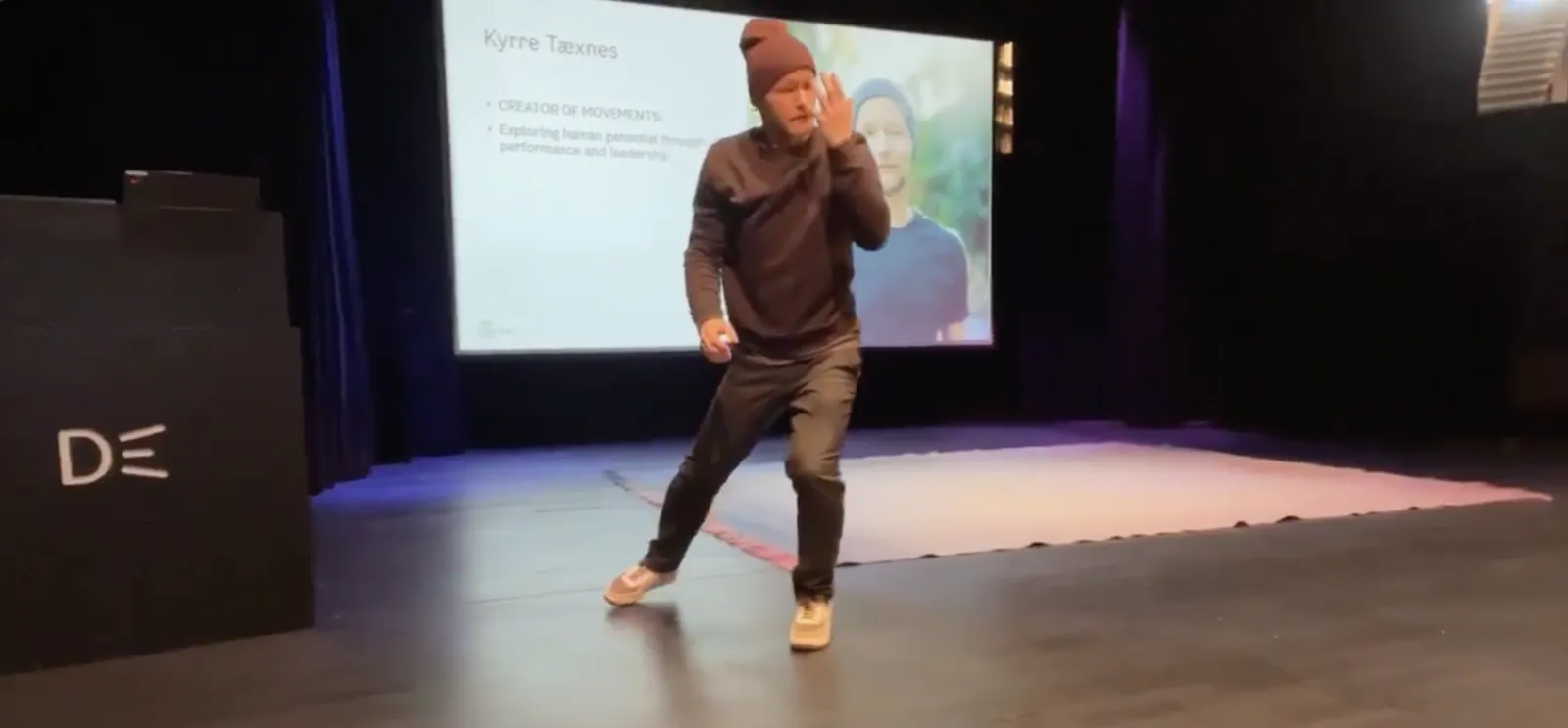
Read all 14 gaits
1. The Purposeful Walk
Long strides, eyes fixed on a point far ahead. We see it when the user marches straight past the desk and all the signs, and three minutes later is on the wrong floor.
Tip: Catch their eye at the door.
2. The Shy Walk
Knock-kneed feet, bent neck and hands pulled into the sleeves. We see it when he has been standing at the notice board for ten minutes, reading the same note. He needs help, but he won't ask.
Tip: Half a step and an open question.
3. The Stressed Walk
Short, hard steps, shoulders up by the ears and three things in your hands. We see it when you need to make the shift change, and someone asks if you have a moment.
Tip: Stop, feet on the floor, one breath before you answer.
4. The Quick-Start Walk
A fast push-off. Great at getting going. We see it when you are at the crime shelf before the user has taken off their hat. But the user is still at the desk.
Tip: Walk at the other person's pace.
5. The I-Do-What-I-Want Walk
Feet kicking forward, knees locking back. We see it when someone takes a video call on speaker in the quiet zone, and lowers their voice for about four seconds.
Tip: Get close, speak quietly, be specific and offer an alternative.
6. The Slouch
Head, legs and torso all going different ways. We see it when five come in at once and become one organism with one shared volume.
Tip: Find the one everyone looks at, and talk to them.
7. The Chest-First Walk
Chest pushed out, big shoulders, swaying side to side. We see it when the printer refuses to print the boarding pass. He isn't angry with you. He's angry with the printer.
Tip: Don't take it personally.
8. The Replay
Slow motion. Lowered shoulders, standing slightly at an angle. We see it when you respond to the printer rage. You can't shout someone down, but you can breathe someone down.
Tip: Calm is contagious.
9. The Cosy Walk
A slow roll through the foot and a torso swaying pleasantly forward. We see it when the regular leans over the desk and tells you about the entire 1970s, while the queue grows.
Tip: Turn slightly towards the next person, and hand him something.
10. The Short-Sighted Walk
Arms slightly raised, as if about to walk into a wall. We see it when the self-service machine beeps, and four people stand still in the queue behind.
Tip: See the queue, not just the problem.
11. The Smooth Operator
A gliding torso, as if covered in sun lotion. We see it when the host welcomes absolutely everyone with a big smile and a little wink.
Tip: Find the balance between friendly and professional.
12. The Wading-Through-Mud Walk
Heavy steps and a sticky push-off. We see it when the librarian heads in to read aloud to 25 ten-year-olds straight after lunch break.
Tip: Take the room before you take the floor.
13. The Dynamo Walk
Flexible knees and a body charging up. We see it when the same librarian bends her knees in the middle of the room, and 25 heads turn.
Tip: Placement and presence.
14. The Shepherd's Walk
Arms out to the sides, calm side steps and eyes counting heads. We see it when it is quarter to closing time and the lights are flashing.
Tip: Lead from the front, don't push from behind.
Every good conversation starts with half a step.
The research behind it
The field is called embodiment, or embodied cognition: Body and mind influence each other in both directions.
The exact way I talk about gaits is not necessarily documented and published in research. But many links between thought, body and nervous system show that it is logical. It is one way of seeing it, built on experience of reading people in movement.
Read the nine findings, with sources
When I watch someone move, the parts of the brain that control and sense my own movement are activated. In dancers this happens more strongly, especially with movements they master themselves. It is not magic, it is training. What I add is detailed observation and being calm myself.
Your walk shows how you are doing. A sad mood shows in the gait: Slower, less arm swing, more slumped.Michalak et al. 2009, Psychosomatic Medicine
Changing your walk changes your thoughts. Participants guided to walk more happily, without knowing why, remembered more positive things about themselves.Michalak, Rohde and Troje 2015, J Behav Ther Exp Psychiatry
Your brain "walks" with the person you watch. In expert dancers, the brain's movement areas were more strongly activated when they watched movements they could perform themselves. Reading movement is training.Calvo-Merino et al. 2005, Cerebral Cortex
We feel others in our own body. The brain's somatosensory areas are activated when we see other people's actions, touch and pain.Keysers, Kaas and Gazzola 2010, Nature Reviews Neuroscience
The impression is shared, but not necessarily right. People agree on what a walk signals, but are often wrong about the personality behind it. Library users read you anyway.Thoresen, Vuong and Atkinson 2012, Cognition
Your body reacts to distance before you think. The amygdala, the brain's alarm centre, regulates personal space and reacts just from knowing someone is standing close.Kennedy et al. 2009, Nature Neuroscience
Putting it into words takes the pressure down. Naming a feeling reduced activity in the amygdala. That is why one sentence works.Lieberman et al. 2007, Psychological Science
Calm is contagious. We automatically mirror other people's facial expressions, voice and posture, and pick up their feelings.Hatfield, Cacioppo and Rapson 1993, Current Directions in Psychological Science
Posture is a tool under pressure. Upright posture under stress gave better mood and more self-esteem than a slumped one.Nair et al. 2015, Health Psychology
Movement opens up new solutions. Creative thinking increased by around 60 percent while people walked.Oppezzo and Schwartz 2014, J Exp Psych
Rules of thumb
Body language works both ways. It affects how you feel, and it shows others how you feel. So every rule of thumb has two sides: Inner and expression.
They are sorted into four rings, from yourself and outwards: Me, us, the library user and dangerous situations. Each ring starts with a main exercise. Below it you will find the tools.
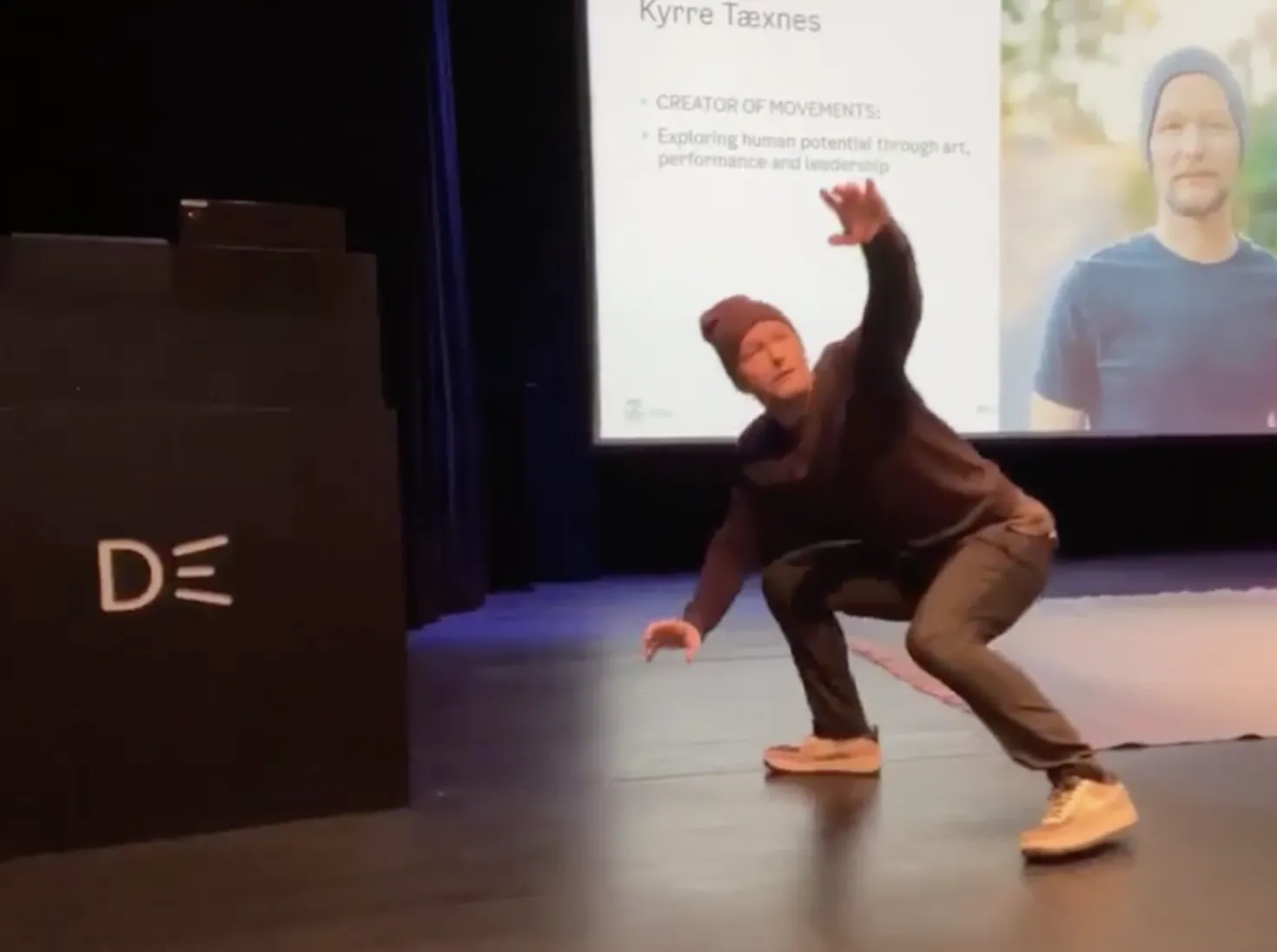
For the big screen in the room, or on your phone: One thing at a time.
Ring 1 Me
Meeting yourself: Stress, energy, guilt and the line towards yourself.
Shake loose, walk in three states
The way you walk and move affects how you feel.
- Shake out your whole body.
- Walk your normal walk.
- Walk as on a heavy day.
- Walk as on your best day.
- Notice: How do you feel inside in each of them?
- Stand still, close your eyes and draw with your hand for 20 seconds.
Tools in this ring
Challenge: Keeping a clear head in the middle of a busy shift.
Free neck
Responsibility tightens the shoulders. Lower them on purpose, bring your focus down into the body that does the work, and let your head be free.
Challenge: Answering a complaint calmly.
Breathe out longer than in
One long out-breath before you answer.
Challenge: Finding calm quickly when a lot is happening at once.
Draw with your hand
Close your eyes and draw a shape in the air with your finger: A circle, a figure eight, even in three dimensions. Picture exactly what you are doing, for 20 to 30 seconds.
Challenge: Getting everything done without getting stressed, for example at a shift change.
Your way of being fast
Know in advance what makes you effective under pressure: A higher pace, more at a time, better organising, asking for help, or keeping your eye on the end result. Choose it, and get your weight down into your legs.
Challenge: Not taking your problems home with you.
The launch pad
Picture the problem and make it small. Launch it into space from a launch pad at the library. Or put it in a container at work, and go home. Shake out your body first, if you can.
Challenge: Switching from the office to the public space.
One breath, one adjustment
Before you step onto the floor.
Challenge: Finding your energy after a heavy day, or on a Monday morning.
Recall the state
Remember a time you were at your best, and walk like that.
Challenge: Standing still and waiting for someone else to take the initiative.
Your body can do it
First see what needs doing. Turn your attention to the action itself, and sense that you have a body that can do it.
Ring 2 Us
Meeting your colleagues: Working together, speaking up and sharing tasks.
Walk in their shoes
See your colleague's movement. It gives understanding without words.
- In pairs. A walks and thinks about a challenge with a colleague.
- B walks alongside and copies A's walk for 30 seconds.
- B says one sentence: «When I walk like you, I feel …»
- Switch.
Tools in this ring
Challenge: Making contact with colleagues when everyone is busy.
Say hello
Make contact, simply.
Challenge: Working well together when you share a task or a shift.
Feel the other before you change pace
Notice your colleague's pace before you set your own.
Challenge: When a colleague disagrees with how you do a task.
See the person behind the issue
Notice how your colleague stands and moves, more than exactly what is said.
Ring 3 The library user
Meeting library users: Seeing people, offering help and wrapping up.
Half a step
The trick is the half step out: Then you decide when the conversation is over.
- In pairs. One is the library user.
- Walk towards the user, take half a step in and ask an open question.
- Finish with half a step out: Weight and direction before the words.
- Switch.
Tools in this ring
Challenge: Staying available while you tidy shelves with users around you.
Soft gaze
Don't lock your eyes on the task. Take in the whole room.
Challenge: Your face can look stern or sour, without you being so.
Smile like the Mona Lisa
A very small smile.
Challenge: The user who needs help but won't ask.
Invite without pushing
Turn, lift your gaze, shift your weight.
Challenge: Approaching someone who can't find their way.
Half a step in
Shoulder slightly angled, and an open question.
Challenge: Meeting the user with full attention, even in the middle of something else.
One moment before you speak
Think: What can I do for you?
Challenge: Ending a conversation with the user who wants to tell you their whole life story.
Half a step out
End with your weight and direction before your words.
Challenge: Several people wanting help at the same time.
Make a map
Notice where they stand in the room in relation to each other. Make a map in your head in order of priority: Who asked first, and who is closest.
Ring 4 Dangerous situations
Meeting challenging, sometimes acute, situations: Anger, setting limits and what feels threatening.
The distance
Your body reacts to distance before you have thought.
- Choose one person and find the distance that feels right.
- Move closer until it gets too close. It is fine to say stop.
- In pairs, up close: Put your attention on your own arm or shoulder. Then you stay in your own body.
- What happens to your breath and gaze when you sense your body?
Tools in this ring
Challenge: Staying steady when someone raises their voice at the desk.
Feet first
Weight down through the whole foot, soft knees.
Challenge: Being put under pressure in a threatening situation.
Gaze down
Lower your gaze about 45 degrees towards the ground.
Challenge: A user who is angry, for example about a replacement charge.
Choose the distance
More distance gives mental contact, less gives emotional.
Challenge: Someone who comes too close.
Feel your body
Notice your arm or shoulder while someone stands close.
Challenge: Explaining a rule to someone who is upset.
See the picture
Picture what you are talking about.
Challenge: Someone who comes in with a lot of negativity and resistance.
Observe, don't fight
See how the other person moves.
Challenge: Being thrown by something unexpected.
Stand with both sides
Soft knees, and both sides of the body slightly active.
Challenge: Speaking up, for example in the quiet zone, without it becoming a conflict.
The right amount of force
No more tension than needed.
Challenge: A conversation that is going nowhere.
Walk away with dignity
Say what you are doing, and say that you are leaving. Then walk away calmly.
What most people take with them is more awareness of their own patterns when meeting library users and colleagues. And the value of sharing challenges with each other.
When you see how uniquely you move, you see how uniquely you meet others.

Experience it again
Put on the music, stand up and walk through the gaits while you listen. When the voiceover ends, the track Clap to the Disco comes on. Then just dance a little.
Stay in touch
Have you taken part in the workshop? You can continue here.
Join a Beveger gathering
Open gatherings at Sentralen in Oslo, where we try the exercises in our own bodies and create something new together. It is free to join. Sign up and we will let you know when the time and place are set.
Which other doors deserve this training?
The reception at a doctor's surgery. The shop where the first impression decides the rest of the visit. The emergency room where people come in afraid. All of these have a bodily communication nobody has consciously taught them. It is not because the training doesn't exist. It is because nobody has thought of giving it to them.
Published July 2026, updated November 2026. Thanks to all the staff at Deichman for their trust. Photo and video: Own material from the engagement.